
Epoxy Kitchen Flooring vs. Tile, LVP, and Laminate: What’s Actually Better?
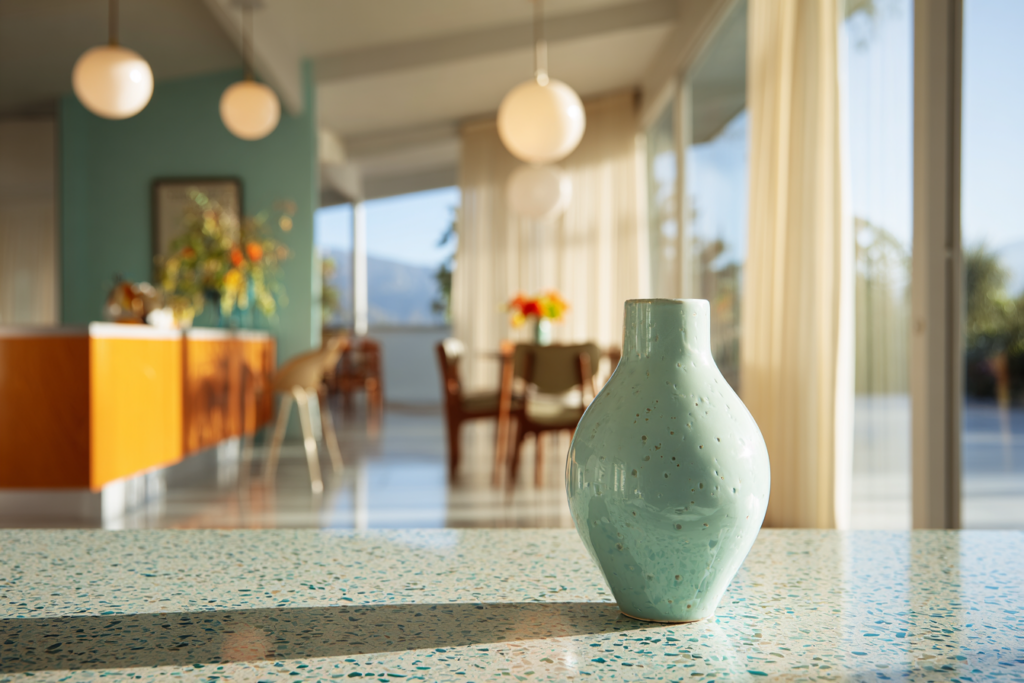
Epoxy kitchen flooring has been all over social media lately. The poured finishes look sleek, almost sculptural, perfect for the high-gloss kitchen aesthetic that’s been trending for the past few years. It’s understandable why homeowners are curious.
But curiosity and commitment are two different things. Flooring is genuinely impressive in commercial settings, garages, and industrial spaces. In a residential kitchen, though, it comes with a list of practical drawbacks that rarely show up in the glossy before-and-after photos. Understanding those trade-offs and knowing what your alternatives actually offer is the difference between a floor you love for 20 years and one you’re already regretting by year two.
We’ve been helping Western North Carolina homeowners choose the right floors for their kitchens since 1971, and we’ve seen what holds up in real homes under real conditions. This guide gives you an honest look at epoxy kitchen flooring, the problems that come with it, and why tile, luxury vinyl plank, and laminate are often the smarter choice for a kitchen in the Asheville or Hendersonville area.
What Epoxy Kitchen Flooring Actually Is
Epoxy flooring is a two-part system: a resin and a hardener that are mixed and applied over an existing surface, usually concrete. When it cures, it creates a hard, glossy, seamless finish. That seamless quality is a big part of its appeal — no grout lines, no seams, no edges to catch dirt.
You’ll see it used in commercial kitchens, warehouses, and auto shops. In those settings, it performs well. The surface is chemical-resistant, easy to hose down, and can handle serious foot traffic. Some homeowners have carried that concept into their residential kitchens, particularly in newer builds with polished concrete subfloors.
The problem isn’t the product itself. The problem is the gap between what epoxy flooring promises and what it actually delivers day-to-day in a home.
The Real Drawbacks of Epoxy
Surface Preparation Is Extensive
Epoxy kitchen flooring doesn’t just go down over whatever surface exists. The subfloor has to be clean, dry, level, and free of cracks, oils, or previous coatings. In existing homes, that often means grinding down the concrete, filling any damage, and waiting for moisture levels to drop to an acceptable range before application can begin.
According to the Epoxy Flooring Association, moisture in concrete is one of the leading causes of epoxy adhesion failure, and many older homes in Western North Carolina have basement slabs and crawl space subfloors that require significant moisture remediation before epoxy can bond correctly (Epoxy Flooring Association, 2023). That prep work adds both time and cost.
This Is Not a DIY Project
Unlike luxury vinyl plank or laminate materials, any reasonably handy homeowner can install on a weekend — epoxy flooring requires professional application. Mixing ratios, ambient temperature, humidity levels, and application technique all affect the final result. A bad mix ratio or a rushed application can result in air bubbles, uneven sheen, fisheye texture, or adhesion failure.
Re-doing an epoxy floor that went wrong isn’t as simple as pulling up a few planks. It requires grinding down and starting over. That’s a costly mistake.
Re-Coating Is an Ongoing Maintenance Requirement
Epoxy kitchen flooring wears over time, particularly in high-traffic areas. The finish can chip, scratch, and dull. When that happens, repair or re-coating requires the same level of prep work as the original installation — grinding, cleaning, and reapplying. This isn’t an occasional deep clean. It’s a significant maintenance commitment that most homeowners don’t account for when they fall in love with the look.
Compare that to the care and maintenance of luxury vinyl planks or laminate floors, which typically require nothing more than regular sweeping and occasional damp mopping.
It’s Hard Underfoot
Epoxy kitchen flooring is applied directly over concrete, which means you’re essentially standing on concrete with a thin coating on top. There’s no give, no insulation, and no warmth. For anyone who spends significant time standing in the kitchen — cooking, doing dishes, helping with homework at the island — that hardness translates to real physical fatigue.
The National Flooring Equipment Association notes that flooring hardness directly affects standing comfort, particularly for people over 50 or those with joint concerns (NFEA, 2023). Kitchens are high-traffic, high-standing areas. The surface underfoot matters.
Slippery When Wet
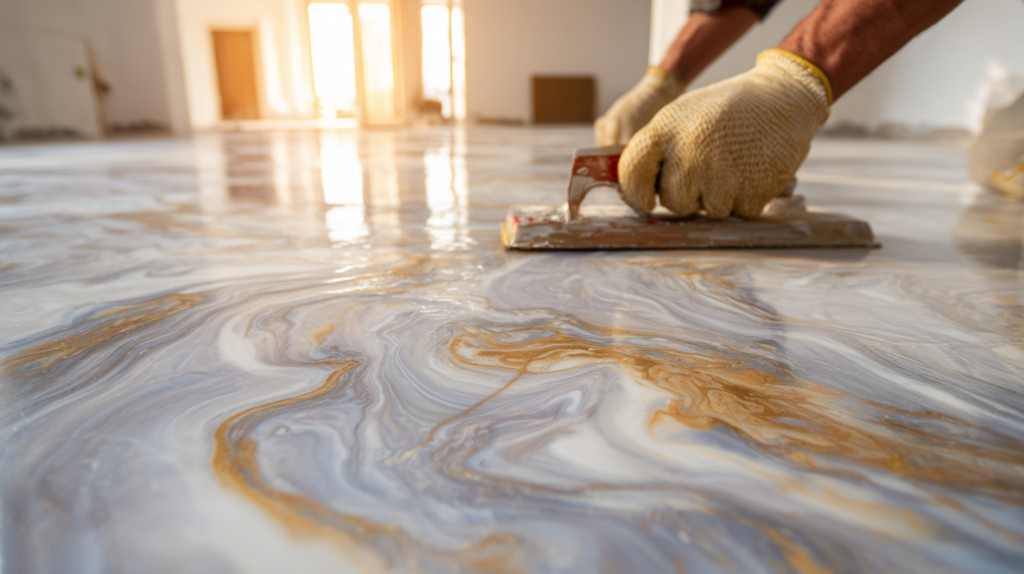
A glossy epoxy kitchen floor is a slip hazard. That smooth, sealed surface provides very little traction when water, cooking oil, or food hits it — which happens constantly in kitchens. While anti-slip additives can be mixed into the topcoat, they reduce the aesthetic quality and wear unevenly over time.
For families with children or older adults, this is a serious safety concern. The U.S. Consumer Product Safety Commission reports that slips and falls are among the most common causes of home injuries, and hard, smooth flooring surfaces are a contributing factor (CPSC, 2024).
Why Tile, LVP, and Laminate Match the Look Without the Problems
Modern flooring technology has come a long way. Tile, luxury vinyl plank, and laminate can all deliver the clean, modern, low-maintenance kitchen floor aesthetic that epoxy promises — without the prep requirements, yellowing, slip hazards, and re-coating cycles that come with it.
Here’s how each option stacks up for epoxy kitchen flooring comparisons.
Porcelain and Ceramic Tile
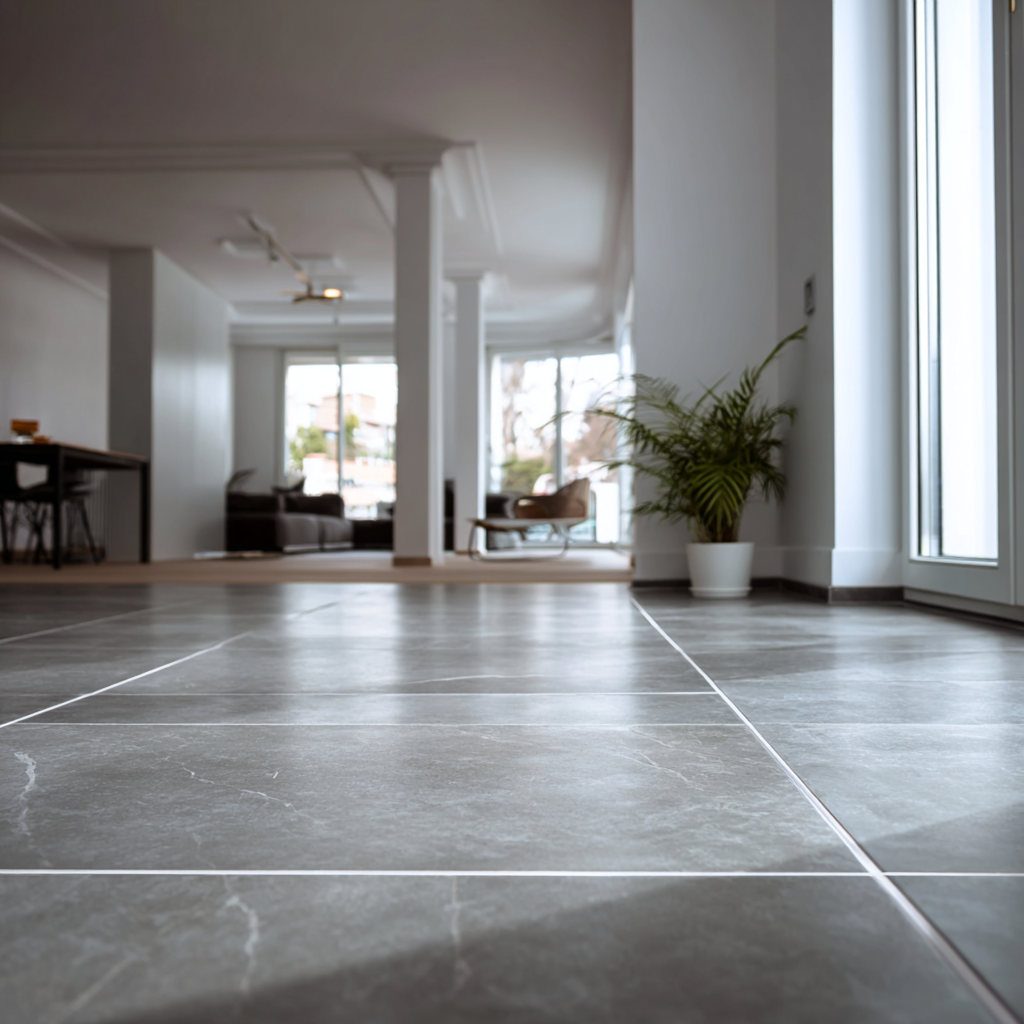
Tile has been a kitchen staple for decades, and for good reason. It’s genuinely waterproof, hard-wearing, and available in an enormous range of finishes — including large-format options that minimize grout lines and closely mimic the seamless look of epoxy kitchen flooring.
Large-format porcelain tiles (24×24 or larger) in polished or honed finishes can achieve a look that’s nearly indistinguishable from poured epoxy in photographs, but they’re cooler to the touch, easier to spot-repair, and won’t yellow. Grout lines, which are often cited as a maintenance concern, are much less of an issue with modern epoxy grouts that are stain-resistant and easy to clean.
Luxury Vinyl Plank (LVP)
Luxury vinyl plank has become one of the most popular flooring choices for a reason — it performs exceptionally well in wet, high-traffic environments. It’s 100% waterproof, softer and warmer underfoot than epoxy kitchen flooring or tile, and available in a wide range of finishes, including realistic stone looks, polished concrete appearances, and large-format designs.
Installation is faster, less invasive, and often suitable for DIY. It can float over most existing subfloors without the grinding and priming that epoxy requires. Brands like Shaw, Mohawk, and Mannington — all American-made products we carry — offer luxury vinyl planks with wear layers thick enough to handle kitchen use for 20 years or more.
Laminate Flooring
Laminate doesn’t get enough credit as a flooring option. Modern laminate from manufacturers like Quick-Step and Pergo features water-resistant cores and sealed edges that can handle kitchen spills — not the subfloor flooding that no flooring should face, but the everyday splash, drip, and cleaning that a kitchen floor lives through.
If you’ve been exploring laminate flooring for your kitchen, it’s worth knowing that today’s options are a significant upgrade from what was available even five years ago. The water-resistance technology has improved substantially.
How Western North Carolina’s Climate Affects Your Decision
One factor that often gets overlooked in generic flooring comparisons is climate. Homes in the Asheville area, Hendersonville, Black Mountain, and throughout Buncombe County deal with significant humidity swings across seasons. Humid summers and drier winters mean your subfloor and flooring materials are constantly expanding and contracting slightly.
Luxury vinyl plank handles humidity swings exceptionally well due to its dimensional stability. Tile is essentially unaffected by moisture. Laminate, properly installed with the right underlayment and moisture barrier, performs well in most WNC kitchen environments.
Our team at Leicester Flooring has been installing floors in mountain-climate homes since 1971, and we understand the specific challenges that WNC humidity presents for different flooring types. It’s one of the reasons we’re careful to match product recommendations to the actual conditions in your home — not just the aesthetic you’re after.
What to Consider Before Choosing Any Kitchen Floor
Beyond the epoxy kitchen flooring comparison, here are the questions worth asking about any flooring option for a kitchen renovation:
Subfloor condition. What’s underneath? Concrete, plywood, or existing tile all affect which materials work best and what prep work costs you’ll encounter before the new floor goes down.
Household traffic and lifestyle. Families with kids, pets, or frequent cooking need flooring that can withstand constant wet exposure and heavy use. Some materials that look beautiful in a showroom show wear quickly in a busy household.
Your comfort priorities. If you cook frequently and spend long stretches on your feet, comfort underfoot matters. The difference between epoxy over concrete and a cushioned LVP with underlayment is noticeable by the end of a long day in the kitchen.
If you’re exploring your options for a kitchen remodel, our room-by-room flooring guide covers what we’ve seen work best for WNC kitchens across different budgets and home styles. And for direct comparisons between the most popular flooring materials, our vinyl vs. tile comparison and waterproof flooring comparison walk through the key differences side by side.
FAQ:
Is epoxy flooring good for residential kitchens?
Epoxy flooring can work in residential kitchens, but it’s better suited to commercial or garage applications. The main issues for home kitchens are UV yellowing, slip risk when wet, hardness underfoot, and the ongoing maintenance of periodic re-coating. Most homeowners find that luxury vinyl plank or tile delivers a similar modern aesthetic while offering significantly better daily performance.
Can you put luxury vinyl plank in a kitchen?
Yes — luxury vinyl plank is one of the best flooring options for kitchens. It’s 100% waterproof, warmer and softer underfoot than epoxy or tile, and available in designs that closely replicate the looks of stone, concrete, and wood. American-made brands like Shaw and Mohawk offer LVP with commercial-grade wear layers, making them suitable for heavy kitchen use.
What is the easiest kitchen floor to maintain?
Luxury vinyl plank is generally the lowest-maintenance kitchen floor. It’s waterproof, scratch-resistant, and requires nothing more than regular sweeping and an occasional damp mop. Large-format porcelain tile with epoxy grout is a close second. Epoxy flooring, despite its seamless appearance, requires periodic professional re-coating to maintain its finish.
Is laminate OK to use in kitchens?
Modern water-resistant laminate from brands like Quick-Step and Pergo can handle standard kitchen moisture—spills, splatters, and routine mopping. It’s not rated for standing water or flooded subfloors. For most kitchens in Western North Carolina, current-generation laminate with sealed edges and moisture-resistant cores is a practical option that performs well for 15 to 25 years.
Why does epoxy flooring turn yellow?
Standard epoxy formulas are not UV-stable. Exposure to natural light causes the resin to oxidize and develop a yellow tint over time. This is particularly noticeable in light-colored or white epoxy kitchen flooring. UV-stable topcoats can slow the process, but typically don’t prevent it entirely. Kitchens with significant exposure to windows are most susceptible.
The Bottom Line on Epoxy Kitchen Flooring
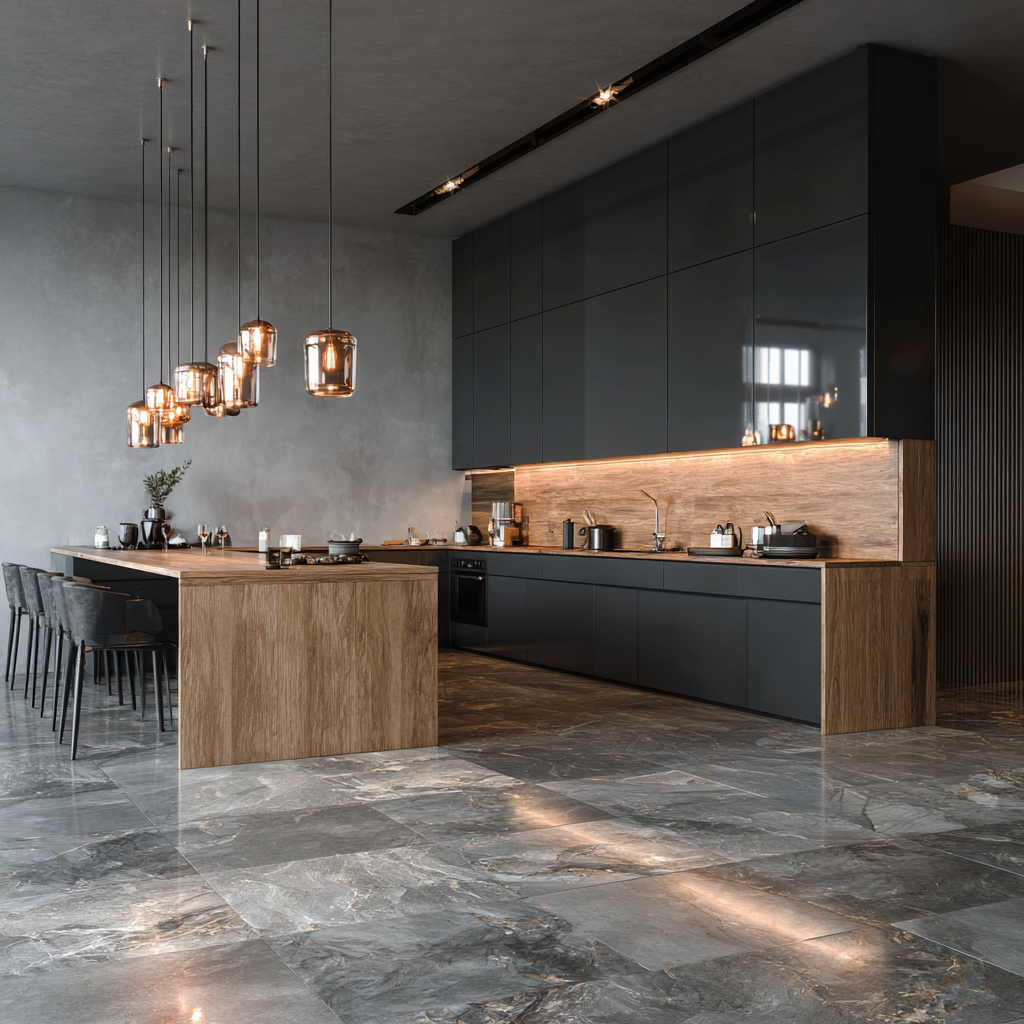
The appeal of epoxy flooring is real. The look is distinctive, modern, and genuinely beautiful in the right setting. But for most residential kitchens, the combination of high upfront cost, demanding installation prep, UV yellowing, slip risk, hardness underfoot, and long-term re-coating requirements makes it a difficult choice to justify — especially when tile, luxury vinyl plank, and laminate can match the aesthetic at a lower cost and with far less maintenance.
At Leicester Flooring and Carpet, we’ve spent over 50 years helping Western North Carolina families find floors that look great on day one and still perform well on year 15. That means being honest when a trendy option isn’t the right fit for a residential kitchen — and pointing you toward the materials that actually hold up in real homes.
Schedule your free in-home measure with Leicester Flooring and Carpet. Our knowledgeable, non-commission sales team will walk you through the best kitchen flooring options for your specific home, lifestyle, and budget. Two showrooms serving Western North Carolina: Asheville and Hendersonville. Contact us here or stop in — we’d love to help.