
9 Tools You Need Before Installing Laminate Flooring
Key Takeaways
- A tapping block and pull bar are the two tools DIYers most often skip and most often regret skipping
- You need both a miter saw for straight cross-cuts and a jigsaw for curves and irregular shapes
- A moisture meter is essential before installation begins, not optional
- Most tools needed for laminate installation are available at any hardware store or tool rental center
- Having the right tools ready before day one saves multiple trips and prevents costly mistakes
Laminate installation is more forgiving than most flooring types, but it rewards having the right tools ready before the first box is opened. The tools on this list aren’t about convenience. Each one serves a specific function that directly affects the quality and longevity of the finished floor. A floor installed with the right tools and the wrong technique can be fixed. A floor installed with the wrong tools usually can’t.
Here are the nine tools you need, what each one does, and what happens when you try to skip it.
1. Miter Saw (or Circular Saw)
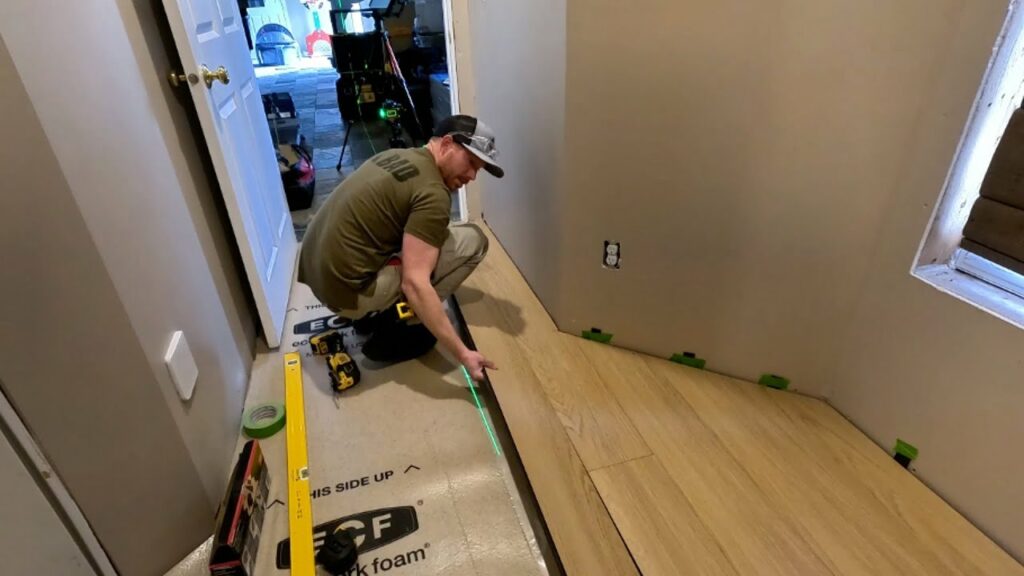
The miter saw is your primary cutting tool for cross-cuts, which are straight cuts across the width of a plank. Most of the cuts in a typical laminate installation are cross-cuts: cutting planks to length at the end of a row, cutting the last plank in a row to fit.
A 10-inch or 12-inch miter saw is the fastest and most accurate option. A circular saw with a straightedge guide works for the same cuts but requires more setup time. Set the plank face-up when using a miter saw; set it face-down when using a circular saw. Laminate chips on the upstroke of the blade, so flipping the orientation prevents chipping on the visible surface.
If you don’t own a miter saw, most hardware stores rent them by the day. For a single-room installation, a rental is a reasonable alternative to purchasing.
2. Jigsaw
The jigsaw handles everything the miter saw can’t: cuts around door casings, pipe cutouts, vent holes, and irregular shapes. In most installations, you’ll use the jigsaw several times per room.
Use a blade with fine teeth (at least 10 TPI, or teeth per inch) to reduce chipping on the laminate surface. When cutting curves or tight angles, drill a starter hole with a drill bit to give the jigsaw room to begin the cut. Always mark cut lines in pencil before cutting.
A jigsaw is also the right tool for notching planks around corners or doorframe profiles where neither a miter saw nor a straight cut would work.
3. Tapping Block
This is the tool most DIY installers skip, and it’s responsible for a disproportionate share of damaged planks and misaligned joints in home installations.
The tapping block is a block of hard wood or plastic that you press against the edge of a plank and tap with a rubber mallet to drive the joint closed. It distributes the force of the tap across the length of the joint, seating it evenly without damaging the tongue-and-groove profile.
Without a tapping block, the impulse is to tap the plank directly with the mallet. That concentrates force on one point of the tongue profile and chips or compresses it. A damaged tongue won’t seat properly, and the joint will have a visible gap or ridge that no amount of tapping will fix. Tapping blocks cost a few dollars at any flooring supply store, or you can use a scrap piece of the laminate itself held at a slight angle.
4. Pull Bar
The pull bar solves the specific problem of installing the final row of planks. When you reach the far wall, there isn’t enough clearance to angle a plank into position or use a tapping block. The pull bar hooks over the plank edge and allows you to use a mallet to drive the joint closed from the end of the plank.
Without a pull bar, the final row either stays unseated with a visible gap, or gets pried into position with a pry bar that damages the plank edge and the wall. A pull bar is inexpensive and essential. Leicester’s installation team considers it a non-negotiable part of the tool kit.
5. Rubber Mallet
A standard hammer is too aggressive for laminate installation. It concentrates impact in a small area, which splits or deforms the tongue-and-groove profile even through a tapping block. A rubber mallet distributes force more broadly and is heavy enough to seat click-lock joints without damaging them.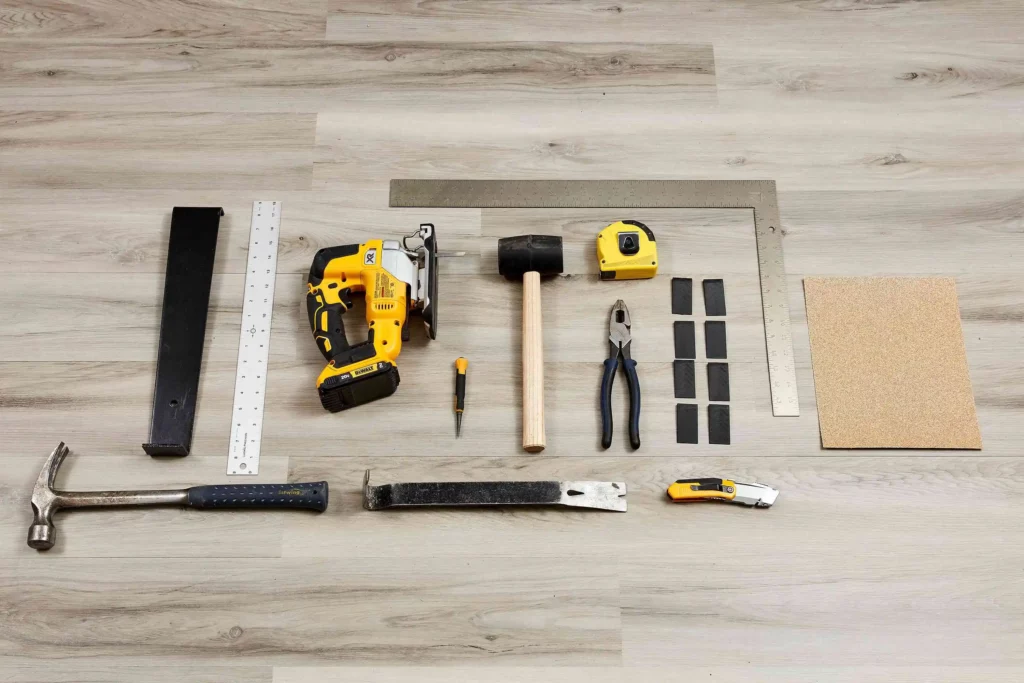
Use the rubber mallet in combination with the tapping block, not in place of it. The mallet provides the force; the tapping block distributes it.
6. Moisture Meter
Skipping the moisture meter is the subfloor preparation step that most often leads to floor failure. High moisture content in a wood subfloor, or elevated moisture vapor from a concrete slab, causes laminate’s HDF core to swell over time. The result is raised joints, buckling, and eventual plank damage that typically isn’t covered under warranty because the root cause was an installation condition.
A pin-type moisture meter is accurate enough for most residential wood subfloor applications. For concrete, a calcium chloride test kit or an in-situ relative humidity probe gives the reliable readings that concrete requires.
Wood subfloors should read below 14 percent moisture content. Concrete subfloors should meet the specific threshold listed in your laminate collection’s installation guide. If readings are elevated, resolve the moisture source before installation. Our subfloor preparation guide explains moisture testing for each subfloor type in detail.
7. Tape Measure and Chalk Line
These work together for layout planning, and layout planning determines whether the finished floor looks intentional or accidental.
Use the tape measure to calculate row widths, confirm that the first and last rows will be approximately equal width, and measure cut lengths accurately. Use the chalk line to snap a reference line parallel to your starting wall so the first row goes in straight regardless of whether the wall itself is straight.
A floor installed without a chalk line almost always drifts off-square by the middle of the room, particularly in older WNC homes where the walls are rarely perfectly parallel.
8. Spacers (3/8 Inch)
The expansion gap at walls and fixed objects is one of the most critical requirements in laminate installation. The standard is 3/8 inch (9.5mm) at every wall, doorframe, cabinet, and fixed object the floor runs against. Without that gap, a floor that expands in summer humidity has nowhere to go and buckles.
Plastic spacers designed for laminate installation are inexpensive and reliable. You can also use 3/8-inch-thick wood scraps cut to a consistent size. Place spacers at every wall and fixed object as you work across the room, and remove them after the final row is installed before baseboards go in.
This matters particularly in Western NC’s mountain climate, where seasonal humidity swings are significant. Our guide on how seasonal temperature changes affect your floors explains why that gap matters more in WNC than in drier climates.
9. Utility Knife and Straight Edge
Once the planks are installed, you’ll need to trim the underlayment that was run up the walls during installation. A sharp utility knife and a metal straight edge make clean, straight cuts along the wall line.
The utility knife is also useful for scoring cut lines before jigsawing, for fine-trimming planks where a millimeter of adjustment makes a difference at a wall, and for removing any adhesive residue from existing flooring if you’re installing over vinyl.
Optional But Worth Having
Knee pads. A full day of laminate installation involves a lot of time on the floor. Knee pads make the work significantly more comfortable without affecting the result.
Oscillating multi-tool. Useful for undercutting door casings more precisely than a handsaw allows. If you have one, use it for door casing work. If you don’t, a handsaw works fine.
Long straight edge or 10-foot level. Useful for checking subfloor flatness before installation begins. A 6-foot level can substitute in smaller rooms, but the longer the straight edge, the better the flatness check.
Tools Leicester Flooring’s Installers Use That DIYers Often Skip
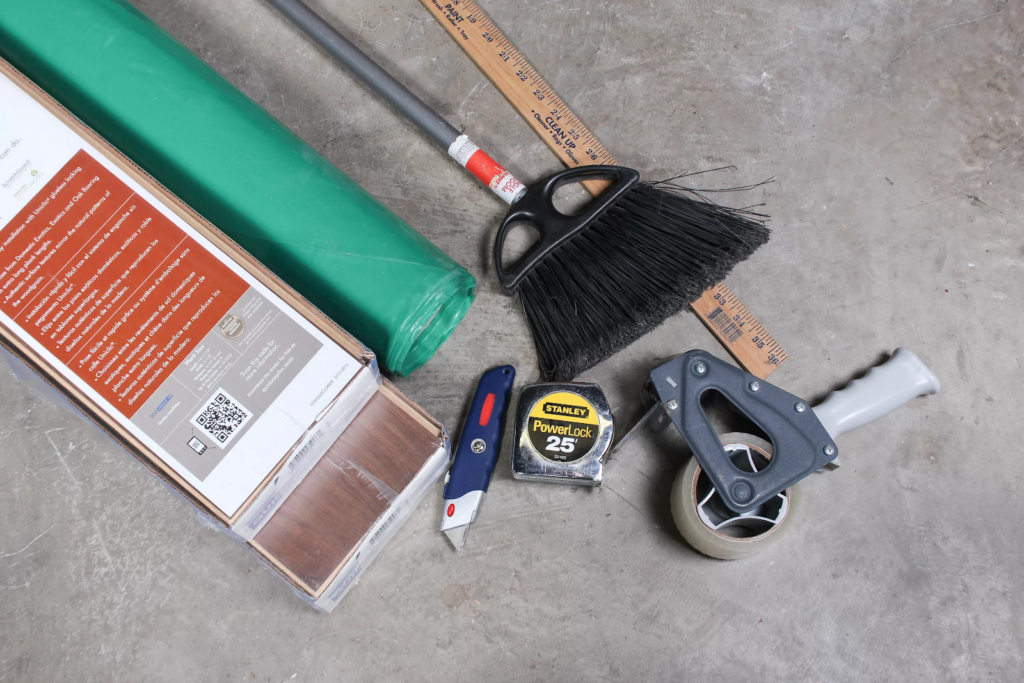
Professional installers bring additional equipment that produces a better result in specific situations: floor scrapers for removing adhesive residue from old vinyl, self-leveling compound applicators for filling subfloor dips precisely, and power drills for securing squeaky subfloor spots with construction screws. These aren’t required for a standard installation, but they explain why professional results look consistently better than typical DIY results in challenging subfloor conditions.
For a full walkthrough of the installation process using these tools, see our complete laminate installation guide. If you’d prefer to have our team handle the installation, book a free in-home measure and we’ll bring all of it with us.
Frequently Asked Questions
Can I install laminate without a miter saw?
Yes, using a circular saw and a straight edge guide. A circular saw makes accurate straight cuts when paired with a clamped straight edge. It’s slower and requires more setup per cut, but it produces the same result. For a small room, this is a reasonable approach.
Where do I get laminate installation tools if I don’t own them?
Most large hardware stores rent miter saws, jigsaws, and moisture meters by the day. Tapping blocks, pull bars, and spacers are inexpensive to purchase and won’t be available for rental at most locations. For a single installation, purchasing the small tools and renting the saw equipment is typically the most cost-effective approach.
Do I need a special blade for cutting laminate?
A standard fine-tooth carbide blade works well for laminate. Blades designed for laminate or melamine have more teeth per inch (60 to 80 TPI on a 10-inch blade) and produce cleaner cuts with less chipping on the wear layer. If you’re cutting a lot of planks, a laminate-specific blade is worth the upgrade. If you’re doing one room, a standard fine-tooth blade is fine.
What can I use if I don’t have a tapping block?
A scrap piece of the laminate flooring itself, held at a slight angle against the plank edge, works as an improvised tapping block. It protects the tongue profile while distributing the mallet force across the joint. Do not tap directly on the plank edge with any tool.